Where Seoul Actually Buys Vintage
Seoul's secondhand scene runs on three tiers — the ₩1,000 piles at Dongmyo, brand vintage on the second floor of Gwangjang Market, and the curated select shops of Seongsu and Hongdae. Which one you want depends on how much digging you enjoy.

Partly personally verified — Daniel checked some of these in person
How we verify →·Last verified ·5 min read
In this guide4
In the space of a few years, secondhand went from an embarrassing word in Seoul to a fashionable one. Among people in their twenties and thirties, vintage and thrift have settled in as a taste category of their own: Seongsu (성수동) filled up with Japanese-style vintage select shops, and the Dongmyo (동묘) flea market is packed with twenty-somethings every weekend. A few things stack up to explain it — new clothes got more expensive, the appetite for owning something other people don't got stronger, the influence of Japanese furugi (used-clothing) culture is heavy, and "look what I found for ₩30,000" does well on social media.
Seoul's secondhand scene sorts roughly into three tiers. Which one you go to depends on what you want.
Seoul secondhand sorts into three tiers. Dongmyo flea market (₩1,000–5,000, clothes piled unsorted on the ground, cash only, best on weekends) — not shopping, digging: fun if you like the lottery of pulling one good thing out of ten. Gwangjang Market's 2nd-floor imported-vintage arcade (₩10,000–50,000, Mon–Sat 10–7, Sun from 11) — brand vintage (Ralph Lauren, Carhartt, Nike) pulled out and hung, vendor-selected, lower failure rate. Seongsu / Hongdae vintage select shops (₩30,000–100,000+) — you're paying for the curation, a piece that'd be ₩5,000 at Dongmyo is ₩50,000 here. Secondhand is basically final sale — check the zipper, seams and smell before buying, and wash before wearing.
Tier 1 — Dongmyo: not shopping, digging
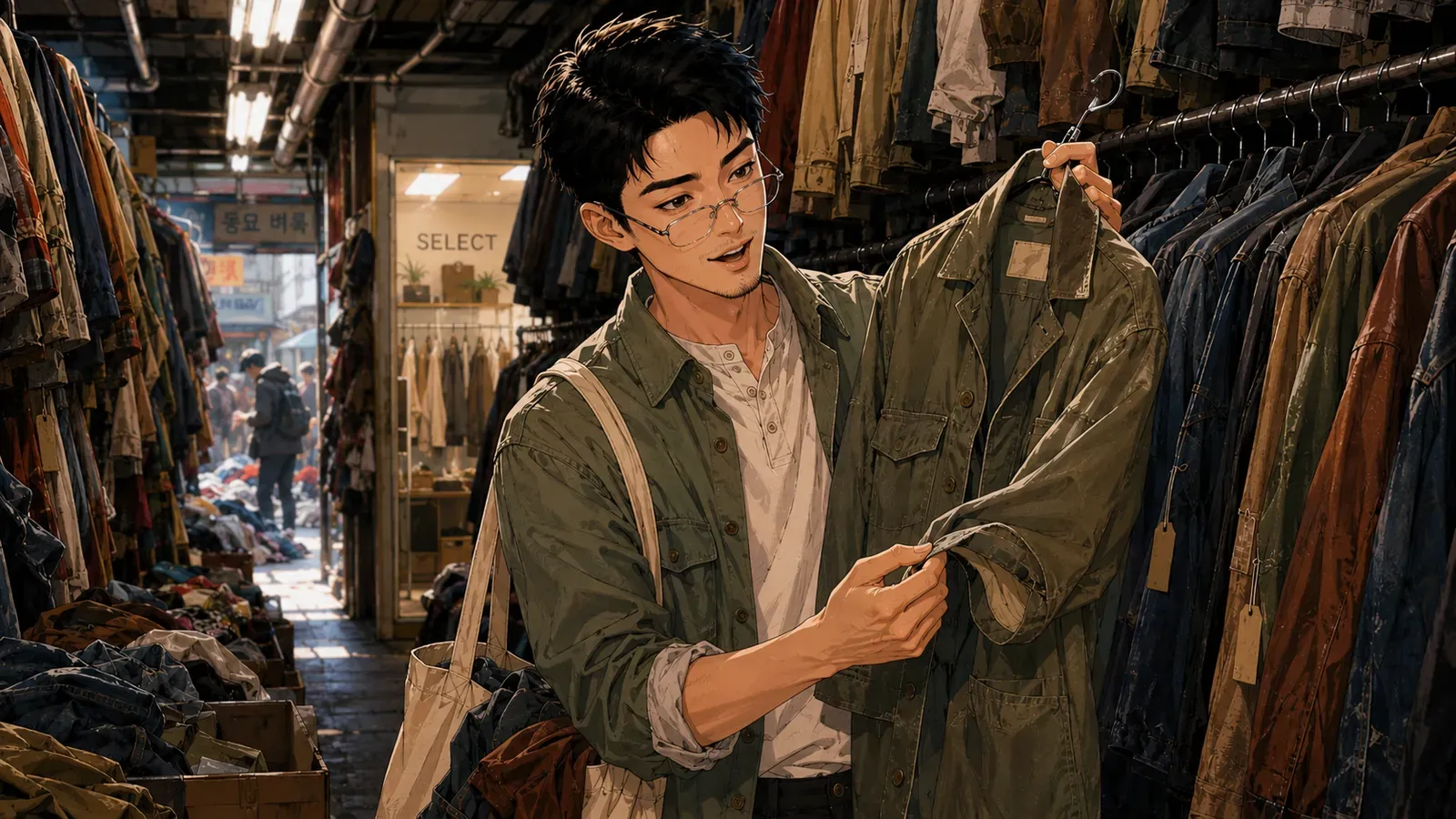
The alleys around Dongmyo-ap Station. Clothes are piled on the ground in heaps, and prices run ₩1,000–5,000 a piece. Nothing is sorted, nothing is sized, and it doesn't always smell great. You dig through with your hands and pull things out. Leather jackets, military surplus, sports jerseys, workwear. Check the condition, haggle, cash only.
- It's there every day, but weekends (Sunday especially) have the most stock and the most people.
- There's old-school market food nearby, so it's a half-day out.
- Honestly: it's a probability game where you dig through ten things to find one. If that's fun to you, there's no better place.
- If the alley scene isn't for you, it's not a wasted trip — there are a few tidy, curated vintage shops in the Seongsu/Hongdae (홍대) style right around Dongmyo that you can switch to.
Tier 2 — Gwangjang Market, second floor: brand vintage
Gwangjang is famous for food, but there's a secondhand-clothing arcade on the second floor (the "imported vintage market"). It's more organized than Dongmyo, with Ralph Lauren, Carhartt, Burberry, and Nike vintage pulled out and hung up, spanning trends from the 1920s to the 1990s. Prices are more like ₩10,000–50,000 a piece. The vendors know their stock and select it, so it's not the Dongmyo lottery, but the failure rate is lower.
- Open Monday–Saturday 10am–7pm, Sunday from 11am. Head in from Jongno (종로) 5-ga Station, exit 8.
- Eat bindaetteok on the first floor, then go up.
Tier 3 — Seongsu and Hongdae select shops: paying for the curation
The vintage select shops in the backstreets of Seongsu and Hongdae. The owner sources pieces personally from Japan or Europe, hangs them by condition, and designs the shop to look good. What's for sale here is less the clothing than the curation — which is why it's expensive. ₩30,000–80,000 for a T-shirt; outerwear over ₩100,000 is common. A lot of these are well-merchandised spaces, so there's something to look at even if you don't buy.
- A piece that would turn up at Dongmyo for ₩5,000 can be ₩50,000 here. That gap is the price of someone having done the picking for you.
- Seongsu folds naturally into a day of cafes and concept shops.
How to decide
- Digging is fun and you don't mind haggling → Dongmyo.
- A brand you recognize, at a fair price, without spending all day → Gwangjang second floor.
- You don't want to strike out, and you enjoy a nice shop → Seongsu / Hongdae select shops.
One thing for all of them: secondhand is basically final sale. Try it on if you can, check the zipper, buttons, underarms, and hem, smell it, then buy. And wash it before you wear it — always.
Three tiers: Dongmyo flea market (₩1,000–5,000, unsorted piles, cash only, open daily but best on weekends); Gwangjang Market 2nd-floor imported-vintage arcade (₩10,000–50,000, brand vintage, Mon–Sat 10am–7pm, Sun from 11am); Seongsu/Hongdae vintage select shops (₩30,000–100,000+, curated, styled spaces). Secondhand purchases are generally non-returnable — check condition before buying and wash before wearing. Prices are typical ranges and vary by item and shop.
 Jay's Tip
Do the tiers in order in a single day if you can: start at Gwangjang for lunch and the second floor, walk or take a short ride to Dongmyo to dig, and save a Seongsu shop for last when you're tired and just want to look. You'll understand the pricing better having seen all three, and you'll know whether the curation is worth it to you or not.
 A Note From Daniel — our real human editor
Dongmyo isn't only the piles — there are proper, organized vintage shops right nearby, the Seongsu/Hongdae kind. If you go to dig and it turns out not to be your thing, just change plans and walk into one of those instead. The one I keep going back to is CEMT (Pilhyeon Building, 1F #105).