Gyeongju From Seoul: The Day Trip Works. The Night Is the Point.
Three clusters, two-plus hours each way. What fits in a day, what needs a night, and why the lights after dark decide it.

Partly personally verified — Daniel checked some of these in person
How we verify →·Last verified ·5 min read
On a map, Gyeongju (경주) looks like one city. In practice it is three clusters: a downtown historic district, the hills with Bulguksa and Seokguram, and the Bomun Lake resort area. From Seoul the constraint is not what to see. It is time: the KTX alone takes more than two hours each way.
- Getting there: KTX from Seoul Station to Gyeongju Station (formerly Singyeongju) takes about 2 hours 5–10 minutes; a standard adult seat is ₩49,300 one way (2026 guides; confirm when you book).
- The station is outside downtown: a taxi into town takes 15–20 minutes (about ₩18,000). Guides give about 30 minutes by city bus, but routes changed in July 2026.
- Day trip: pick the downtown cluster only. Round-trip transit alone is roughly 4–5 hours (our estimate).
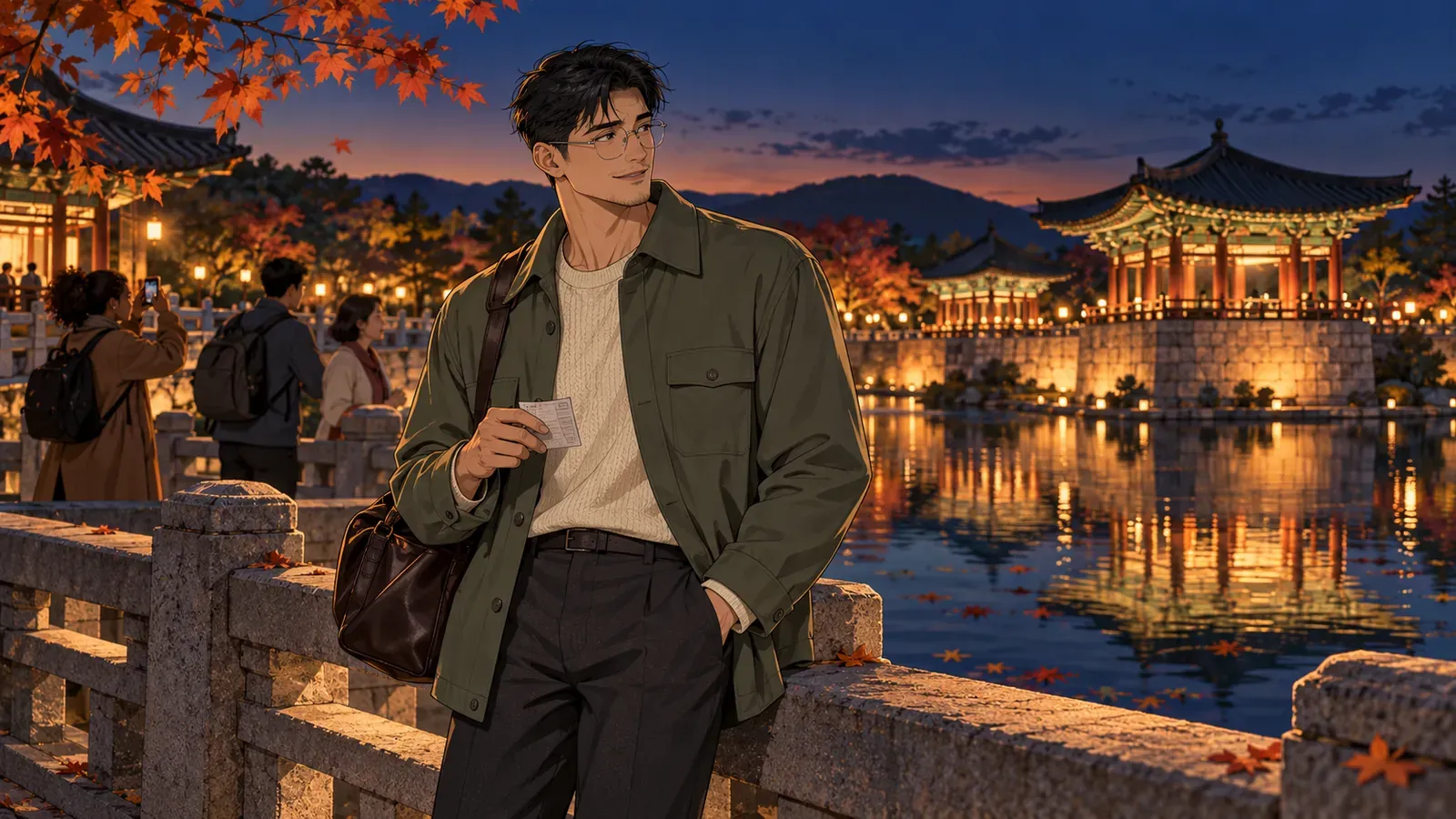
- Verdict: stay one night. Donggung Palace and Wolji Pond after dark (₩3,000, last entry 9:30 p.m.) and Cheomseongdae's night lighting (free, until 10 p.m.) are what a Seoul day trip cannot give you.
- Autumn: foliage peaks in October–November, the same window that fills Seoul. Book earlier than you think.
How long does it actually take to get from Seoul to Gyeongju?
The KTX takes about 2 hours 5 to 10 minutes from Seoul Station (서울역) to Gyeongju Station (경주역), and a standard adult seat costs ₩49,300 one way, per a July 2026 guide and a September 2024 guide that agree. Promotional fares and seat classes vary, so pick your date in the booking app and read the price there. If your dates land on a holiday, read what to do when trains sell out first.
Gyeongju Station is the former Singyeongju Station (신경주역), and it is not in the middle of town. A taxi into town takes 15 to 20 minutes, around ₩18,000. Guides give about 30 minutes by city bus. Note that the city reorganized bus service around the station on July 15, 2026, so routes 50, 51, 70, 700, 710 and 711 now pass through the station area. Check which bus reaches the Daereungwon and Hwangnidan-gil area in a map app before you go (see our essential apps guide).
Do the arithmetic. Four-plus hours on the train, about an hour on station transfers, leaves a day trip with roughly five to six hours on the ground. That is our estimate, not an official figure.
Can you see it all in one day?
| Cluster | What's there | Cost (2026) | Jay's call |
|---|---|---|---|
| Downtown historic district (walkable) | Daereungwon (대릉원) tombs and Cheonmachong (천마총), Cheomseongdae (첨성대), Donggung Palace and Wolji Pond (동궁과 월지), Gyeongju National Museum, Hwangnidan-gil (황리단길) | Daereungwon park free; Cheonmachong ₩3,000 · Wolji ₩3,000 (both 9 a.m.–10 p.m., last entry 9:30 p.m.) · Cheomseongdae free · National Museum free | The only cluster a day trip needs. Start in the afternoon and stay until the lights come on. |
| Bulguksa (불국사) and Seokguram (석굴암), in the hills | UNESCO World Heritage temple and grotto. Seokguram is viewed through a glass wall. | Entry free since May 2023 · last entry 5:00–6:00 p.m. depending on season | Hard to add to a downtown day without rushing. Better as the next morning. |
| Bomun Lake (보문호) | Lakeside paths and resorts | Walking is free | Skip on a day trip. Worth it in foliage season. |
 A Note From Daniel — our real human editor
Gyeongju keeps Silla's remains remarkably well preserved, and you can feel that history almost everywhere. At Bulguksa and Seokguram you get a sense of Silla-era Buddhist culture. Standing in front of Seokguram, there is a calm and a mystery that is hard to put into words. I keep wondering how anyone made the interior so perfectly balanced in ancient times.
Why is one night the better answer?
Wolji is a different place after dark. The pond reflects the lit pavilions, and the site admits visitors until 9:30 p.m. and closes at 10, which is a squeeze if you are watching the last train home. Cheomseongdae has no admission fee and its lights stay on from sunset until 10 p.m., so it slots easily into an evening walk.
A Note From Daniel — our real human editorDon't skip Cheomseongdae. It looks very different by day and at night, and I'd urge you to see it at night. With the moonlight and the surrounding lights, it is the kind of sight you find yourself looking at for a long time.
Gyeongju is not only ruins. Hwangnidan-gil takes its name from Hwangnam-dong, the neighborhood, and Gyeongridan-gil, the trendy Itaewon street, and it packs cafés and restaurants into lanes lined with 1960s–70s buildings (Korea Tourism Organization). Most shops keep roughly 10 a.m. to 9 p.m. hours, and some of the smaller dessert counters close before the evening crowd peaks.
Jeonju reaches the same verdict for a different reason: there, the problem is how much of the village is commerce; here it is distance and time. If you are pairing Gyeongju with Busan, see where it sits among the towns between Seoul and Busan, and if you are linking several cities, compare it with renting a car.
When should you go?
Foliage runs October to November, the same window that fills Seoul hotels (see Seoul by month). Plan the evening around Wolji's 9:30 p.m. cutoff, and arrive 20 to 30 minutes before sunset if you want the lights to come up while you are there.
One day: the downtown cluster and nothing else. One night: downtown on day one, Bulguksa the next morning. Bulguksa and Seokguram stop admitting visitors between 5:00 and 6:00 p.m. depending on the season, so morning is the low-stress slot.
- Gyeongju Station is the former Singyeongju: KTX takes about 2 hours 5–10 minutes, ₩49,300 standard adult one way.
- Taxi into town takes 15–20 minutes; check bus numbers in a map app after the July 2026 route changes.
- A day trip means the downtown cluster only.
- Wolji admits until 9:30 p.m.; Cheomseongdae is free and lit until 10 p.m.
- Save Bulguksa for the next morning: entry is free, and admission closes at 5–6 p.m.