MU:DS, Korea's Museum Goods: What Sells and What's Worth Buying
Korea's museum goods now sell ₩41.3 billion a year. Here are the kinds that actually sell, what they cost, and which are worth your money.

Partly personally verified — Daniel checked some of these in person
How we verify →·Last verified ·7 min read
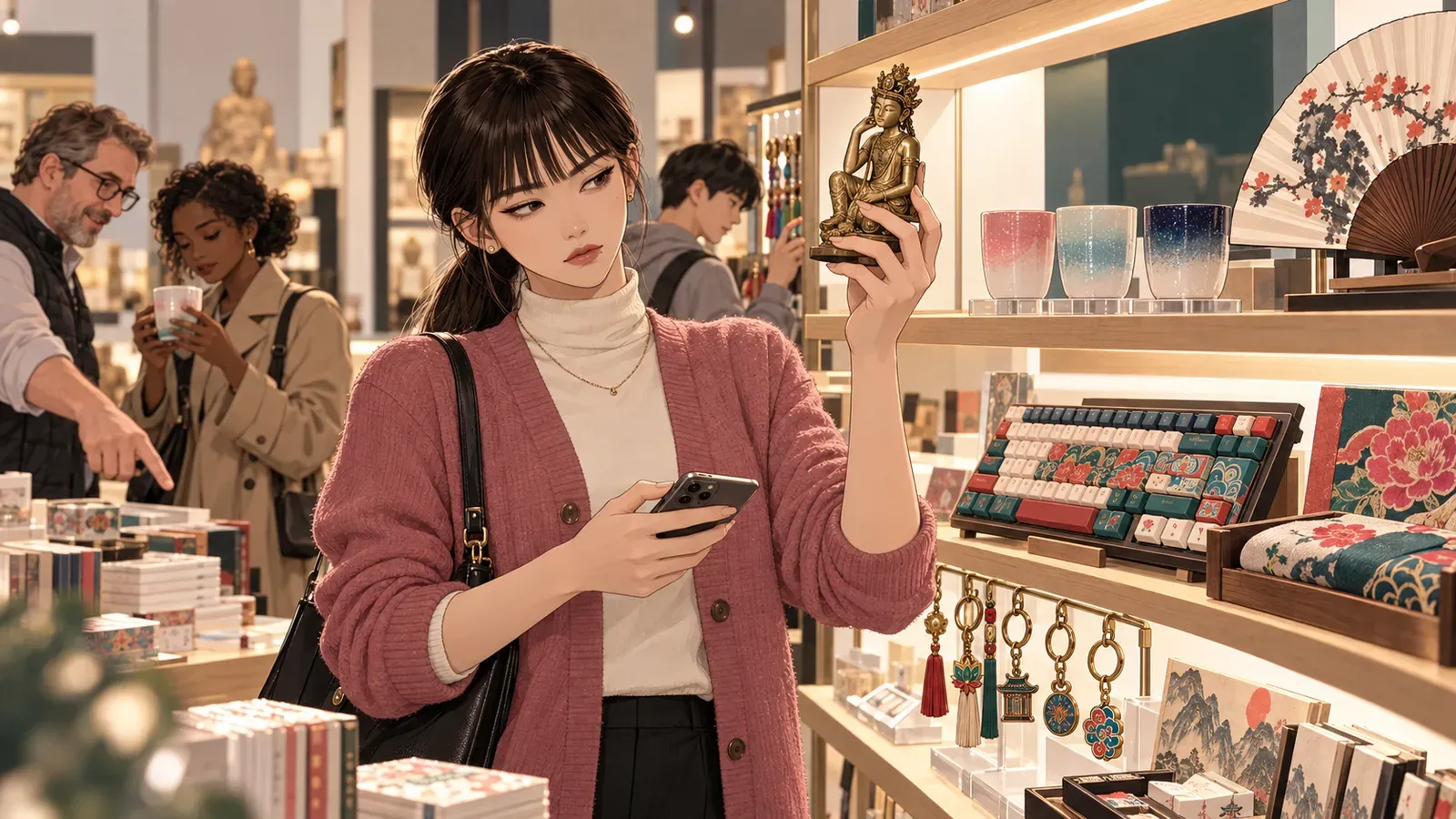
If you have never heard the word 뮷즈, you are in good company. It is written MU:DS in English, a blend of "museum" and "goods", and it is the name of the official goods line made from the collections of Korea's national museums: replica miniatures, tableware, stationery, even keyboards, sold in museum shops and online. The National Museum Foundation of Korea runs it.
Korean museum goods used to be postcards and magnets. The numbers say otherwise now. MU:DS sold ₩41.3 billion in 2025, 1.9 times its 2024 total, and ₩21.8 billion in the first half of 2026 alone, up about 90% on the same stretch last year. About 90% of what the museum shops sell offline goes to domestic visitors. These are things Koreans buy to use.
- Five kinds of goods carry the sales: display miniatures, drinkware, desk gear (keyboards, key-cap keyrings), small pins and fans, and tableware.
- The proven best-sellers: the Pensive Bodhisattva miniature (₩65,000; 61,000+ sold in total), the color-changing "tipsy scholars" cup set (₩26,000; about 60,000 sets in 2025), and the magpie-and-tiger pin (₩14,900; about 90,000 in 2025).
- The practical ones sell out. The dancheong (단청) keyboards (the wireless model is reported at ₩145,000) and the National Seal key-cap keyring (₩38,000) have repeatedly sold out; the keyring sold out online and in store.
- Regional national museums sell their own goods too: Jeonju, Iksan, Gyeongju, Daegu and others, available through the online shop.
- What we couldn't confirm: whether the shops offer tax refunds or international shipping. Ask at the counter.
What kinds of MU:DS goods actually sell best?
Sales figures exist for only a few items, so the table starts with those. Prices are listing prices from reports between October 2025 and September 2026, so check the shop before you plan around them. You can browse everything on the official online shop at museumshop.or.kr, and its best-sellers page is the quickest place to start. The shop's pages are in Korean, so use your browser's translate button.
| Type | Item | Price | Sold |
|---|---|---|---|
| Display piece | Pensive Bodhisattva miniature (반가사유상) | ₩65,000 | 61,000+ in total |
| Drinkware | "Tipsy scholars" color-changing cup set (취객 선비 변색잔) | ₩26,000 | About 60,000 sets in 2025 |
| Pin | Magpie-and-tiger badge (까치호랑이 배지) | ₩14,900 | About 90,000 in 2025 |
| Desk gear | Dancheong keyboards (단청 키보드), made with custom-keyboard maker C.E.dot | ₩145,000 (wireless) | Sold out at launch |
| Desk gear | Goryeo celadon Bluetooth keyboard | ₩145,000 | — |
| Desk gear | National Seal key-cap keyring (국새 키캡 키링) | ₩38,000 | Sold out at launch |
| Tableware | Silla roof-tile chopstick-rest set (3 pieces) | ₩18,000 | — |
| Tableware | Celadon cup set (with potter Shim Bo-geun) | ₩39,000 | — |
| Small goods | Folding fan (도유연행도) | ₩11,000 | — |
| Stationery | Bookmark set, nine pieces, gold-plated, with booklet | ₩30,000 | — |
Staff at the National Museum of Korea (국립중앙박물관) said in July 2026 that the steady sellers are the wine stoppers and the spoon sets, rather than the sold-out viral items.
Which of these are practical, not just pretty?
More than you'd expect, and that is the real change. The practical lines run from keyboards and cups to lamps, hand cream, bags, hats, blankets and notebooks.
- Keyboards and key-cap keyrings. The dancheong (단청, the painted patterns on palace and temple woodwork) keyboards come in wireless and wired models and are built with the custom-keyboard maker C.E.dot on its K515 model. The National Seal key-cap keyring is a keyring and a key cap for a mechanical keyboard in one. It was chosen in the foundation's 2026 design competition, drawing on the Korean Empire's national seal from the National Jeonju Museum and a royal seal from the National Chuncheon Museum.
- Cups and drinkware. The color-change set only reacts to cold drinks: the faces shift color below 18°C, most clearly at 10°C or lower, so it's a cold-drink cup, not a hot-tea one.
- Tableware. Chopstick rests, wine stoppers (including ones tied to the Yi Sun-sin exhibition) and spoon sets are the quiet best-sellers.
- Paper goods. Fans, handkerchief sets and bookmarks.
Our read: a keyboard at ₩100,000 or more should be judged as a keyboard, so check the switch type and layout before you pay for the pattern. A ₩11,000 fan or a ₩18,000 chopstick-rest set is the low-risk buy: you will use it, and it fits in a suitcase.
What are shoppers actually posting about?
Sales reports tell you what the foundation sold. Shoppers' own posts show what they care about once the item is in their bag. On Instagram and Threads over the past year, three patterns kept coming up. It's a small sample, and likes are not sales.
- New releases sell out, and fans say so. A late-July 2026 post listing the 2026 competition winners marked the gat (갓, the horsehair hat) umbrella, the Geumgangsan gonggi and a key ring as temporarily sold out. Its most-liked reply, with 69 likes, asked the shop to make more.
- Buyers brag about the items nobody expected to love. An August 2026 Threads post by a shopper who bought a handkerchief at the museum shop drew about 4,300 likes. The caption said the traditional pattern looked almost European. If you walk past the textile shelf, you may be skipping the best-looking thing in the shop.
- Independent makers announce the practical items. Designers whose work was chosen in 2026 posted about a ceramic magnetic parcel cutter and a roof-tile chopstick rest that will also come as a two-piece set.
What do the regional museums sell?
MU:DS isn't only the shop in Seoul. National museums elsewhere design their own products from their own collections, and many are sold through the online shop.
- Jeonju: a clutch and card wallet based on the museum's bandaji chest (반닫이).
- Iksan: a scarf and handkerchief with patterns from a gilt-bronze reliquary case.
- Gyeongju: a Seokguram keyring and a stickers set from the Cheonmado painting.
- Daegu: ballpoint pens with a black-hat cord and a bridal-headdress design.
- Buyeo: a gilt-bronze incense burner miniature, reported sold out.
On September 1, 2026 the foundation launched a 100-item collection (26 "daily" items and 74 "craft" items) drawing on national museums' collections, sold online and in eight museum shops. The competition that picked the National Seal keyring runs each year, so new regional products keep arriving.
 A Note From Daniel — our real human editor
The museum I visited most recently was the National Iksan Museum (국립익산박물관) in North Jeolla. The keyboard on the shelf had dancheong patterns on it, its keys were marked in Hunminjeongeum-style lettering (훈민정음, the original document of the Korean alphabet), and it had a noise-reducing feature. At about ₩150,000 it was pricier than I expected, but it isn't only pretty, so I could see why. I only looked and didn't buy it. The keyboard was the one expensive thing: nearly everything else in the shop was ₩10,000 to ₩30,000, which felt like an easy buy.
Why do some items sell out, and how do you handle it?
Because the shop sells at a set price and the most photographed items are limited runs. The National Seal key-cap keyring and the Geumgangsan rainbow-stripe gonggi (색동공기, a traditional jacks-like game) were sold out both online and in the store as of late July 2026, with restocks planned but not dated. One buyer's guide noted that the keyring had a per-person purchase limit when sales reopened.
- Check the online shop before you visit. Stock shown there is often the only way to tell whether a trip is worth it.
- Don't plan the visit around one item. If your must-have is a sold-out limited run, treat it as a bonus.
- Weekday mornings are still busy. A reporter who visited on a Monday morning in July 2026 found the shop crowded.
- Buy from the museum or its online shop. Resale listings exist on third-party platforms; we did not compare their prices, so use the official channels if you want the listed price.
Who is buying, and where do you buy as a visitor?
In 2025, shoppers in their 30s were the largest group (35.4%), followed by the 40s (25.9%), 50s and over (16.4%), 20s (12.5%) and teenagers (9.8%). Offline stores brought in 56.6% of the sales, online 29.5% and corporate orders 13.6%.
As a visitor, the main shop is at the National Museum of Korea in Yongsan (where the shops are inside the museum). Regional goods are available online and in some regional museums' own shops. We could not confirm whether the museum shops offer tax refunds for foreign visitors or ship abroad, because the official shop site blocks our access, so ask at the counter before you assume either.
If you're planning a gift run, see how these compare with Korean stationery brands, homeware and ceramics, the concept shops and the supermarket souvenirs. For what else to see in the museums themselves, start with Seoul's museums and galleries.
So which MU:DS goods are worth your money?
| If you want | Buy | Verdict |
|---|---|---|
| A safe gift under ₩20,000 | Fan, chopstick rests, magpie-and-tiger pin | Low risk, light, used |
| Something to show off | Pensive Bodhisattva miniature (₩65,000) | Worth it only if you want it as a display piece |
| A real desk upgrade | Dancheong or celadon keyboard (about ₩145,000 for the wireless models) | Judge it as a keyboard, not as a souvenir |
| A talking point | Color-changing cup set (₩26,000) | Cold drinks only |
| A limited run | National Seal key-cap keyring (₩38,000) | Don't plan around it; it sells out |
 Yuna's Tip
Decide the purpose before the shelf. A gift you'll hand over in two days and a keyboard you'll type on for three years are different purchases. If you want the story and not the object, the pin and the fan carry it for under ₩15,000.
MU:DS is the museum-goods brand of the National Museum Foundation of Korea. 2025 sales were about ₩41.3 billion (2024: about ₩21.3 billion); first-half 2026 sales were about ₩21.8 billion. In 2025, offline stores were 56.6% of sales, online 29.5%, corporate 13.6%; domestic visitors made up 90.4% of offline buyers. Prices in this article are listing prices from reporting between October 2025 and September 2026 and may change. We could not confirm tax-refund eligibility or international shipping. Social-media observations come from a small sample of public Instagram and Threads posts.