Jjimjilbang 101: What Actually Happens Inside a Korean Public Bathhouse
No swimsuits, mixed-gender saunas in uniform, and a key that might double as your tab — what to actually expect your first time.

Partly personally verified — Daniel checked some of these in person
How we verify →·Last verified ·6 min read
In this guide6
A jjimjilbang can be disorienting the first time — people of every age wandering around in identical uniforms, one room freezing cold and the next running like a sauna, a whole section of people asleep on a heated floor. The process itself, though, is more straightforward than it looks. Once you know it, it just flows.
Pay at the counter, get a key, leave shoes at the rack, find your locker. The bathing area is gender-separated, done without clothes (no swimsuits), and you must shower thoroughly before any tub — no phones or photos. The communal jjimjil (sauna) area is mixed-gender and uniform-only — this is the real draw: themed sauna rooms, a heated sleeping floor, and a food stall, so people stay for hours. Tattoo policy is set per venue, not by law — larger and tourist-facing places are more relaxed, but call ahead for a large visible tattoo. Cost is typically ₩10,000–20,000 for around 12 hours, which makes it a common budget place to crash (e.g. after the last train). Your entry key usually doubles as your tab — tag it for food and settle when you hand it back; body scrubs are run by independent contractors and often need cash separately.
What happens when you first enter a jjimjilbang?
Pay at the counter and you'll get a key (or a receipt). Shoes come off at a separate shoe rack near the entrance, and once inside, you find the locker matching your key number. Clothes go in there — and what you wear next depends on where you're headed: the bathing area is gender-separated, while the communal jjimjil (sauna) area is mixed-gender, uniform required.
What are the jjimjilbang bathing-area rules?
The single most important rule: shower thoroughly before getting into any tub. It's shared water, so cleanliness comes first. Swimsuits aren't worn — the norm is bathing without clothes. If you have long hair, tie it up or wrap it in a towel so it doesn't touch the water. Phones and photography are off-limits entirely in the bathing area.
Can you go to a jjimjilbang with tattoos?
Tattoo policy is set by each individual venue, not by law, so it varies a lot. Historically many places turned away visible tattoos due to an association with organized crime, but that's loosening these days. Larger venues and ones used to tourists tend to be more relaxed about it, but if you have a large, visible tattoo, it's worth calling ahead to check. (Getting inked in Seoul yourself? Here's where fine-line studios actually cluster and what changed legally in 2026.)
What's in the communal jjimjil (sauna) area?
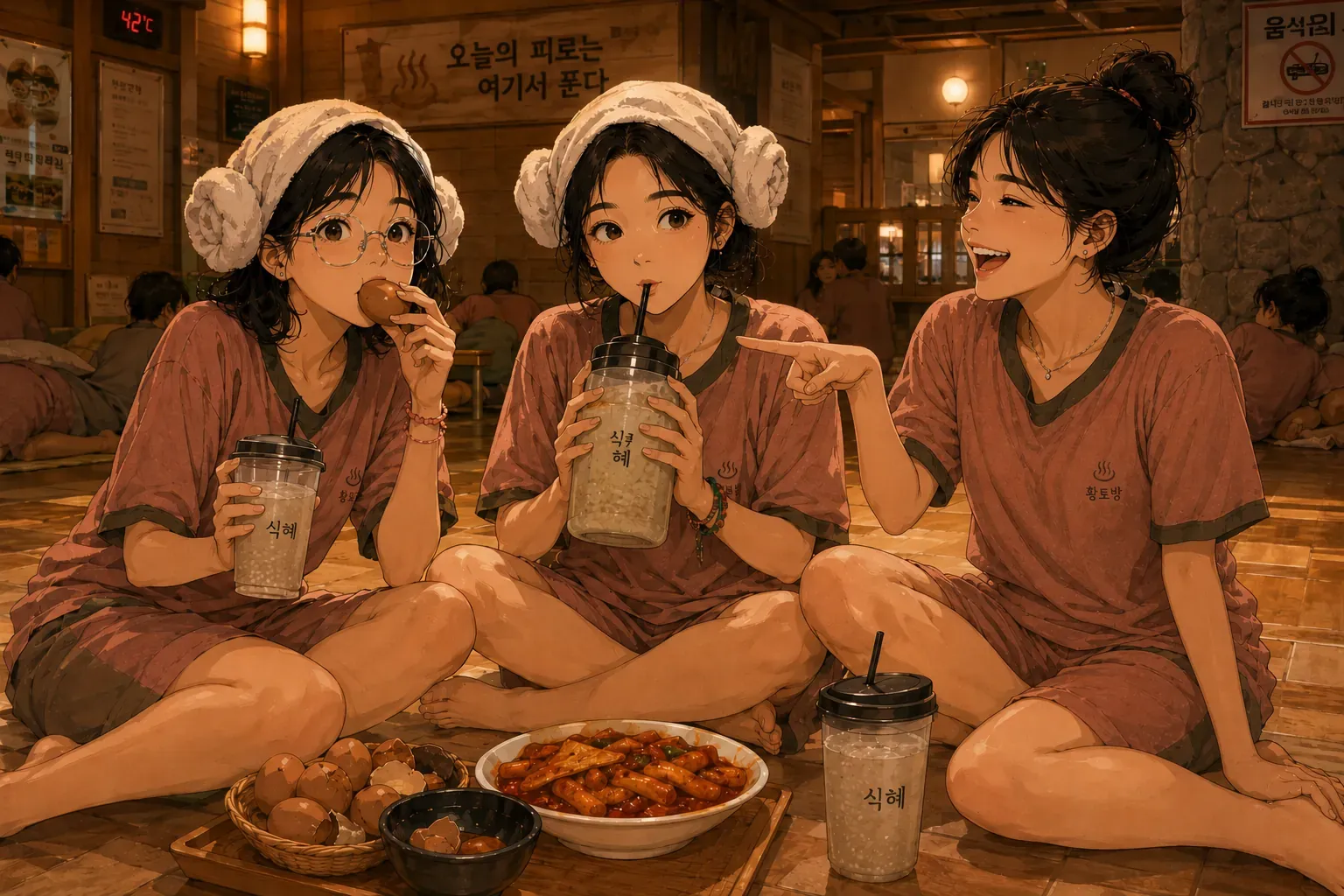
This is the actual draw — a row of themed sauna rooms (clay, salt, ice, oxygen, and others), and you move between them freely in your uniform. There's usually a floor-heated sleeping room where people nap for a while, plus an on-site food stall selling things like sikhye (sweet rice drink) or eggs, so people end up staying for hours without really planning to.
 A Note From Daniel — our real human editor
I go to a jjimjilbang with my kid every so often, and the food quality genuinely surprises me — sometimes the food court beats a proper standalone restaurant. The menu's more varied than you'd expect, too, from gukbap (a hot rice-and-broth soup) the older regulars love to donkatsu (a Korean take on the breaded pork cutlet) that wins the kids over.
Can you sleep overnight in a jjimjilbang?
At roughly ₩10,000–20,000 for something like 12 hours in many places, it's common enough to double as a cheap overnight option — whether you missed the last train or just want a low-cost place to crash. (See our guide on missing the last train in Seoul for more on that angle.)
How do you pay inside a jjimjilbang?
It's easy to assume the key you get at check-in is just for your locker, but at a lot of jjimjilbangs it also works as your payment method. Tag it at a terminal next to the counter whenever you buy or eat something inside, and you settle the whole thing in one go when you hand the key back at the front desk on your way out. One exception: body-scrub services are usually run by independent contractors inside the building, so that part sometimes needs cash on its own.
 Rae's Tip
If it's your first time, a larger chain used to tourists is the easier entry point. If you have visible tattoos, call ahead. If you want a body scrub, ask for it separately at the counter — it's not included in the basic entry fee. And you can leave your wallet in the locker for most of the visit — that one key usually covers it.
Entry order is key/receipt → shoe rack → locker. The bathing area is gender-separated, clothing-free, requires a shower before any tub, and bans photography; the communal jjimjil area is mixed-gender and uniform-only. Tattoo policy is set per venue, not by law — larger and tourist-facing venues tend to be more relaxed. Cost typically runs ₩10,000–20,000 for roughly 12 hours, though this varies by venue and time of day. At many venues, your entry key also functions as a tab — settle up when you leave.