Where Did K-Pop Demon Hunters' Tiger and Magpie Come From? The Korean Folk Art Behind the Film
Derpy's goofy look is a centuries-old joke. Here is the minhwa, the grim reapers and the ritual blades behind the film, and where in Seoul to see the real thing.

Research-verified — cross-checked against independent sources

How we verify →·Last verified ·6 min read
In this guide8
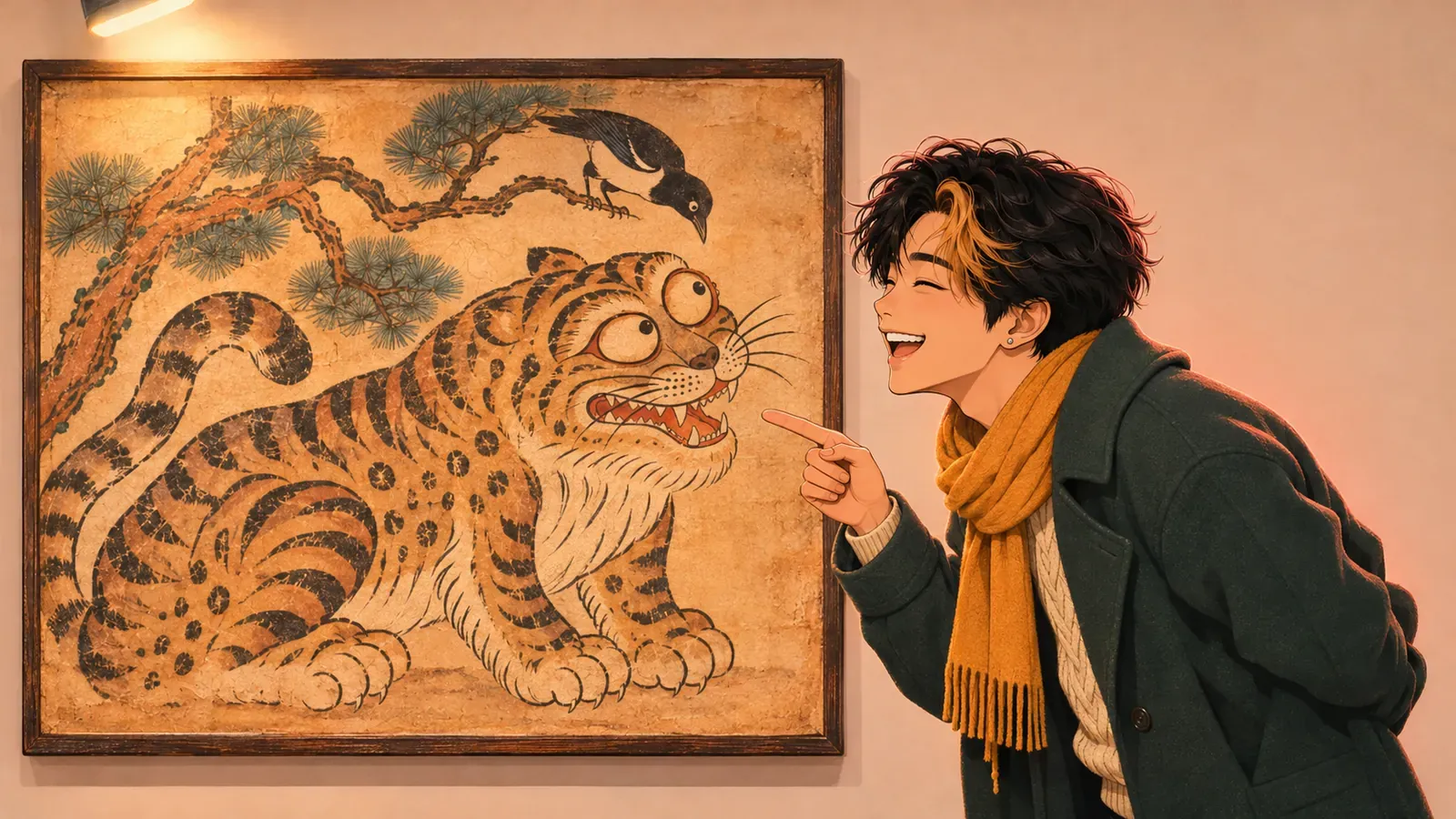
Why does Derpy look so dopey? Because the old paintings do. It's a very old joke, and the film just borrowed it.
- Derpy and Sussie come from a Korean folk-painting genre, the tiger-and-magpie painting (hojakdo, 호작도). Co-director Maggie Kang said the tiger's design is based on minhwa, and story artist Radford Sechrist put it at "90%" minhwa, 10% the crew's cat (Salon, July 2025). Netflix's own character page says the same.
- In the old paintings, the tiger usually plays the fool. The tiger wards off evil and, in one common reading, stands for a pompous official; the magpie brings good news and stands for ordinary people.
- The Saja Boys' name works two ways. Saja means lion, and jeoseung saja (저승사자) is the underworld messenger of Korean folklore. Their gat hats echo Joseon scholars.
- Not everything in the film has a folklore source. The Honmoon, the weapons and the pendants are tied to Korean traditions by press and tourism boards, but we found no folklore source for the demon king Gwi-Ma.
- To see the real thing in Seoul: Gahoe Museum in Bukchon (about 10 minutes from Anguk Station Exit 2, closed Mondays). Hands-on classes run ₩3,000–25,000, and entry is free if you wear hanbok.
Where do Derpy and Sussie come from?
A tiger with a magpie beside it is a hojakdo (호작도), also called jakhodo (작호도) or kkachi-horangi (까치호랑이): one of the best-known subjects in Korean folk painting, or minhwa (민화). Director Maggie Kang told Salon that the tiger's design is based on this minhwa, and that he's called Derpy because the traditional tigers are "very derpy." Story artist Radford Sechrist said the design is 90% based on the minhwa artwork and 10% on the crew's own cat (Salon, July 2, 2025). Netflix's own character page (November 4, 2025) says he is "based on the babo horangi (바보호랑이), a recurring figure in Korean minhwa." The Korea Tourism Organization's August 2025 guide likewise says both characters were inspired by the genre.
One distinction matters. That the tiger comes from minhwa is the creators' own statement. The magpie link rests on the tourism board's description; we found no creator quote about it. The six eyes are the film's own invention (Sechrist). The bird's tiny hat is a different case: Sechrist says it came out of a brainstorm, while the Korea Times reads it as a nod to an old visual joke in the painting tradition (July 4, 2025). That is a reporter's interpretation, not a creator's explanation. Spelling varies by outlet, Sussy or Sussie; Netflix's own page uses Sussie.
Why is the tiger silly in the old paintings? There are several readings. The tiger drives off evil and the magpie brings good news, which made the pair a popular New Year's charm painting (sehwa, 歲畵) according to a Korean report that cites the Encyclopedia of Korean Culture. Another reading casts the tiger as a pompous official and the magpie as the common people (Salon, Sisaweek, Vogue Korea). In autumn 2025, the Leeum Museum of Art showed seven tiger-and-magpie works until November 30 and presented a 1592 painting as the genre's prototype (Vogue Korea, November 3, 2025). The film inherited a very old joke.
Where do the Saja Boys come from?
The name has two layers. Saja (사자) is the word for lion, and the jeoseung saja (저승사자) is the underworld messenger of Korean folklore who guides souls to the afterlife (Korea Herald, July 26, 2025). The Korea Tourism Organization notes that the group's gat (갓), a Joseon scholar's hat, and their job of guiding souls both echo Korea's traditional reapers. The classic look of black hanbok plus gat was popularized by the KBS series Korean Ghost Stories in the 1970s and '80s, the Korea Times reports. Kang herself told Sports Hankook that images like the jeoseung saja and the dokkaebi (goblin) feel fresh to Western audiences (August 30, 2025). We couldn't find a reliable source tying any specific film character to the dokkaebi, so we haven't drawn that link.
What about the Honmoon, the weapons and the accessories?
The table below shows who says what.
| In the film | Korean source | Who says so | How solid |
|---|---|---|---|
| Derpy (tiger) | Hojakdo; minhwa's "babo horangi" | Kang, Sechrist (Salon, Jul 2025); Netflix | Creators, studio |
| Sussie (magpie) | The magpie in the same genre | Korea Tourism Organization (Aug 2025) | Tourism board |
| Saja Boys' name | Jeoseung saja; also "lion" | Korea Herald (Jul 2025), KTO | Press, tourism board |
| Saja Boys' look | Black hanbok and gat (scholar's hat) | KTO; Korea Times | Tourism board, press |
| Honmoon (barrier) | Shamanic gut ritual; hon = soul, moon = door | Korea Herald | Press reading |
| Rumi's sword | Sain-geom (四寅劍), ritual sword made at tiger hours | Korea Herald ("Four Tiger Sword") | Press reading; no crew confirmation |
| Mira's pole arm | Goguryeo-era curved pole arm (gokdo) | Korea Herald | Press reading |
| Zoey's spirit knife, pendant | Gut ritual knife; norigae ornament | Korea Herald, KTO | Press, tourism board |
| Stage floor, backdrop | Dancheong; Irworobongdo throne screen | KTO; Korea Times | Tourism board, press |
| Gwi-Ma (demon king) | No folklore source found | — | No source |
What is minhwa, exactly?
Minhwa (민화) means "people's painting." It boomed among ordinary Koreans in the late Joseon period, and it decorated everyday things: folding screens, chests, pillowcases, fans. These were pictures meant to bring luck and keep bad energy out. The classic subjects include the tiger-and-magpie painting, character paintings that turn a written word into a picture (munjado), peonies, flower-and-bird scenes (hwajodo) and bookshelf still lifes (chaekgeori). What matters is that this was art for the home, not the palace.
Where can you see minhwa in Seoul?
At Gahoe Museum (가회민화박물관) in Bukchon. Its official site lists minhwa, folk objects, talismans and shaman paintings in its collection. You don't need the film. It's a one-hour stop.
- Where: 52 Bukchon-ro, Jongno-gu. Line 3 Anguk Station Exit 2, about 10 minutes on foot. Walk toward the Constitutional Court and past a CU convenience store; the museum is in that building's basement. There's no parking.
- Hours: March–November 10:00–18:00, December–February 10:00–17:00. Closed Mondays. Last entry is 40 minutes before closing.
- Free entry: children under 5, visitors 65+, Art Pass holders, visitors wearing hanbok, and May 1–31 (museum-and-gallery weeks). The museum's page doesn't list the general ticket price, so we haven't printed one. Call 02-741-0466 before you go.
- English: The museum's pages say nothing about English guidance. Don't assume it.
Hands-on sessions run 10:00–16:00, with last entry one hour before they end. A selection from the museum's price list (the page is undated, and the site was updated in 2026):
| Hands-on program | Price | Time |
|---|---|---|
| Zodiac animal stamp | ₩3,000 | 15 min |
| Dancheong pattern card | ₩5,000 | 20 min |
| Wood panel painting | ₩15,000 | 60 min |
| Folding fan painting | ₩18,000 | 60 min |
| Wish talisman print (framed) | ₩18,000 | 60 min |
Most programs are for elementary-school age and up. The site doesn't describe individual booking. Groups of ten or more need a phone reservation and a ₩50,000 deposit. The full price list runs from ₩3,000 to ₩25,000. To pair it with a hanbok rental and a Bukchon walk, see our Bukchon guide.
One distinction: the Irworobongdo that inspired the stage backdrop isn't minhwa. It's a court painting that stood behind the Joseon king's throne, and the tourism board says you can see it at Gyeongbokgung's Geunjeongjeon Hall. Our palace comparison covers the visit.
What about a tiger-and-magpie souvenir?
The National Museum of Korea's Kkachi-Tiger pin, and which pop-ups have ended, are covered in our KPop Demon Hunters in Seoul guide. Gahoe's site also has shop sections for minhwa goods and books, but we couldn't see stock or prices. Think of it as a place to ask, not a sure thing.
Is there anywhere in Seoul that tattoos minhwa?
Yes, and it shows how long this painting has kept its fans. Onsil Ink in Gwangjin-gu is an appointment-only studio that artist Haesol Choi opened in 2021, and it turns minhwa into large custom tattoos. According to a Korea Herald interview on September 5, 2026, roughly 95% of his clients are foreign nationals by his own count, and the tiger-and-magpie pairing "comes up constantly." Apparently plenty of people want a goofy-faced tiger on their forearm. The interview never mentions KPop Demon Hunters, so we can't say the film is behind it.
What I like is how different this is from the tattoo most people picture when they hear "oriental tattoo." That usually means Japanese irezumi: fierce oni and hannya masks, carp and dragons, images meant to intimidate. A minhwa tiger is another animal entirely: dopey, friendly, with a wink in it. Onsil Ink's pitch is that humor is exactly what Choi is trying to carry into Korean traditional tattooing, and that every design is made for one person. He redraws the wishes packed into these paintings (the magpie for good news, the tiger for warding off bad energy, cranes and pine trees for long life) as a one-off design that fits what each client wants, which is how the studio works. And since minhwa began as pictures ordinary families hung at home to invite good fortune, putting one on your skin is a natural extension of the original idea.
We emailed Onsil Ink the questions people are most likely to have about minhwa tattoos, and it wrote back. Custom minhwa pieces start at around ₩300,000, the studio told us, and the final number depends on size, placement and detail. You send the design and size you have in mind, have a free consultation, and get a quote for that piece. Consultations are available in English, Korean and Japanese, and booking opens monthly, so if you're flying in, aim for four to six weeks ahead. The studio is about a five-minute walk from Exit 3 of Children's Grand Park Station on Line 7, one stop from Konkuk University Station. It shares the exact address only after a booking is confirmed.
One heads-up: the studio told us it uses single-use needles for hygiene. With tattoo rules in transition ahead of the Tattooist Act in 2027, still ask about hygiene in the consultation and book only if you feel comfortable (see our fine-line tattoo guide). To get to know the artist first, read the Korea Herald interview.
Joon's call
Minhwa is trending in search because of the film, but the paintings are fun without it. If you're already in Bukchon, give it an hour. Don't cross the city just for it.
- The tiger's minhwa roots were stated by the film's director and story artist. The magpie and the rest come from tourism-board and press readings.
- We found no folklore source for the demon king Gwi-Ma.
- Gahoe Museum: closed Mondays, 10:00–18:00 March–November (until 17:00 December–February), free in hanbok. The official page lists no general ticket price.
- Hands-on programs ₩3,000–25,000 per the museum's site (undated page). English guidance is not confirmed.
- Minhwa tattooing (Onsil Ink) is by appointment, from around ₩300,000 per the studio, with the final quote after a free consultation. Single-use needles per the studio (as of 2026-11-06).
Sources4
Official pages we checked this article against.
- Derpy the tiger: character bio (KPop Demon Hunters)Netflix Tudumchecked Nov 6, 2026
- KPop Demon Hunters: Culture & TravelKorea Tourism Organizationchecked Nov 7, 2026
- Visitor information (hours, free admission)Gahoe Minhwa Museumchecked Nov 7, 2026in Korean
- Regular hands-on programs and pricesGahoe Minhwa Museumchecked Nov 7, 2026in Korean