How to Actually Ride the Seoul Subway
The Seoul metro is easy — cheap, English-signed, runs to midnight. Here's only the part that trips people up: which card to buy, the transfer discount, express trains, exit numbers, and rush hour.

Partly personally verified — Daniel checked some of these in person
How we verify →·Last verified ·5 min read
In this guide6
The Seoul subway is one of the easier things about visiting — it's cheap, well-signed in English, dense, and runs until around midnight. But a few things trip people up the first time, so here's just those. The app side (Naver Map) and the cash-and-topping-up side live in other guides; this is what you need standing at the gate.
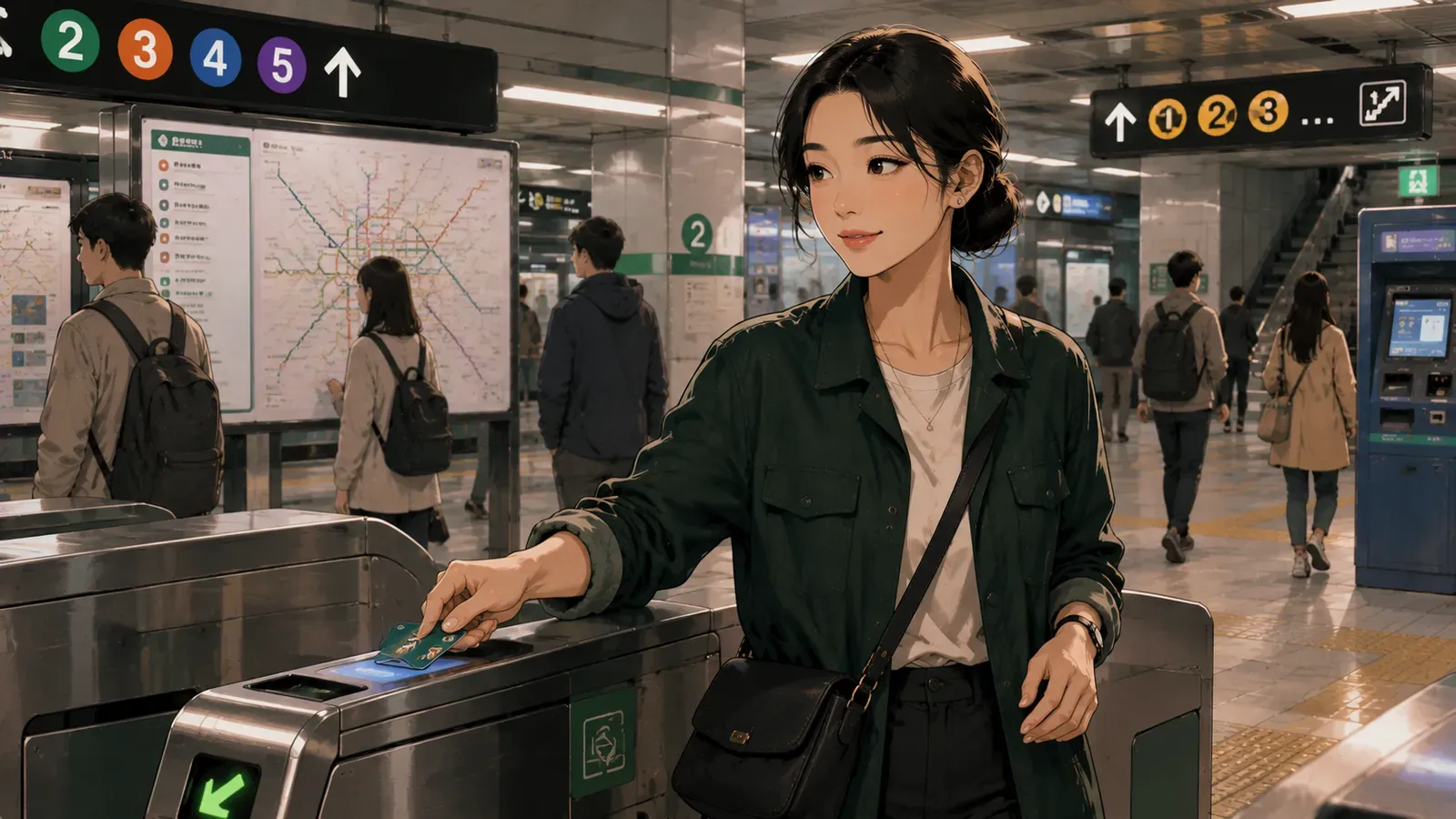
Cheap, English-signed, dense; trains run until around midnight. Base fare ₩1,550 by card, distance-based — tap out on exit or you get a penalty next trip. Pay with a T-money card (best for most people), a Climate Card tourist pass (unlimited Seoul subway + city bus, ~₩5,000–20,000 for 1–7 days plus a one-time ₩3,000 for the card, Seoul only, pays off at about four rides a day), or a single-journey ticket (₩1,650 fare + ₩500 refundable deposit, no transfer discount). The transfer discount — same card, within 30 minutes of alighting (60 minutes between 9pm and 7am), up to four transfers per connected journey — makes subway↔bus effectively one continuous fare, which is why a card beats single tickets. Since March 2026, designated station kiosks accept overseas Visa/Mastercard/UnionPay for single-journey tickets and short-term Climate Card passes, not ordinary T-money top-ups. Check your exit number before you go — wrong exits at big stations cost 10 minutes.
| How to pay | Best for | Cost | The catch |
|---|---|---|---|
| T-money card | Most visitors | Card free–cheap; base fare ₩1,550/tap | Buy and top up with cash at a station or convenience store |
| Climate Card pass | Four or more rides a day | ~₩5,000 (1 day) to ₩20,000 (7 days) + ₩3,000 card | Seoul only — excludes outer Gyeonggi, airport buses, red express buses, Han River bus |
| Single-journey ticket | One or two rides total | ₩1,650 fare + ₩500 deposit (refunded after exit) | No transfer discount |
How do you pay for the Seoul subway?
- A T-money card (the answer for most people). Buy a physical card at a convenience store or station, top it up with cash, tap once for subway, bus, and taxis. Buying and charging it: see the 3 apps you need and do you need cash in Seoul.
- A Climate Card tourist pass (if you ride a lot). Unlimited subway and city buses: roughly ₩5,000 for 1 day, ₩8,000 for 2, ₩10,000 for 3, ₩15,000 for 5, ₩20,000 for 7 (2026 figures — confirm), plus a one-time ₩3,000 for the physical card. It pays off at about four rides a day. But it's Seoul only — it excludes outer Gyeonggi routes, airport buses, red express buses, the Ttareungi bikes, and the Han River (한강) bus. A day trip to Suwon or Chuncheon (춘천) means paying for that leg separately (see our day-trip breakdown for what those legs actually cost).
- A single-journey ticket. At the station machine, choose your destination, insert ₩2,150 (₩1,650 fare + ₩500 deposit). After you exit, put the card into a "deposit refund" machine in the station for your ₩500 back. No transfer discount. Not worth it unless you're only riding once or twice.
- Note: since March 2026, Seoul-designated station kiosks accept overseas Visa/Mastercard/UnionPay for single tickets and short-term Climate Card passes, not standard T-money top-ups. The city notes an overseas-card processing fee. The AREX airport line's Express (direct) train does not take T-money or Climate Card — you buy a separate ticket. The All-Stop train takes T-money, and the Climate Card works on it only in Seoul (Seoul Station to Gimpo Airport): you can tap out at Incheon Airport T1/T2 but you can't tap in there, so the trip from the airport into the city needs a separate fare.
How much does the Seoul subway cost?
The base fare is ₩1,550 by card (₩1,650 for a single ticket), with small increments every 5km past the first 10km. Most trips inside Seoul are the base fare or ₩100–300 over. You must tap out on exit for it to calculate correctly — skip it and you'll get a penalty on the next trip.
Do you get a free transfer between subway and bus in Seoul?
If you transfer subway-to-bus, bus-to-bus, or bus-to-subway on the same card, you're not charged twice — the distance just continues. Conditions: within 30 minutes of tapping out (1 hour between 9pm and 7am), up to four transfers in one connected journey. Cash and single tickets don't get this. It's the reason to use a physical card or a Climate Card.
How do you read the Seoul subway map and exit numbers?
- Lines are colour + number (Line 2 green, Line 3 orange). Stations have numbers too (Hongik Univ. is 239). Naver Map will tell you "Line 3, second stop, transfer to Line 4 at 328."
- Exit numbers really matter. Big stations have exits numbered up to 14, and coming out the wrong side can mean a 10-minute detour at street level. Check which exit number your destination is, and follow the exit signs from the platform.
- Transfers are signed by line colour inside the station, but a few (Express Bus Terminal, Jongno (종로) 3-ga, Wangsimni) have long transfer corridors — budget 5–8 minutes of walking.
Which Seoul subway lines have express trains?
Line 9, parts of Line 1, the Suin-Bundang line, and the Gyeongui-Jungang line run express trains that stop only at some stations — if your stop isn't an express stop, it blows right past it. Check the platform display and the floor markings (express / local). The Line 9 express is especially crowded.
When is rush hour, and what's the subway etiquette?
- Weekday mornings 8–9 and evenings 6–7:30 are genuinely packed; Lines 2 and 9 are the worst. Avoid if you can, and never board those with a suitcase at that hour.
- The priority seats at the ends of each car stay empty even when the train is full — it's the custom not to sit there.
- Keep calls short, no speakerphone or video sound, backpack on your front or down by your feet.
- Let people off before you get on. If you're by the door, step out at each stop to let others pass.
 A Note From Daniel — our real human editor
Beyond the priority seats at the ends of the car, you'll sometimes see seats marked in pink, usually mid-car. Those are kept empty for pregnant passengers — not occupied-if-free, empty, even on a packed train. Visitors sit in them without realising and get some odd looks. Treat the pink seat the way you'd treat the priority seats: leave it.
Traveling with a stroller or a child who needs a car seat changes the choice of route. Our getting-around-with-kids guide covers that decision separately.
Pay by T-money card (most people), a Climate Card tourist pass (unlimited Seoul subway + city bus, ~₩5,000–20,000 for 1–7 days plus ₩3,000 for the card, Seoul only), or a single ticket (₩1,650 fare + ₩500 refundable deposit, no transfer discount). Base fare ₩1,550 by card, distance-based. Tap out on exit. Transfer discount (same card, within 30 min, up to 4 transfers per connected journey) makes subway↔bus effectively one fare. Since March 2026, designated station kiosks accept overseas Visa/Mastercard/UnionPay for single-journey tickets and short-term Climate Card passes, not ordinary T-money top-ups. AREX Express doesn't take T-money/Climate Card; the All-Stop train takes T-money, and the Climate Card works on it in Seoul (Seoul Station–Gimpo Airport) and to exit at Incheon Airport T1/T2, not to board there. Lines 9, 1, Suin-Bundang, Gyeongui-Jungang have express trains that skip stations. Check your exit number before you travel. Trains run until ~midnight — for after that, see the missed-last-train guide.
 Soo's Tip
The single mistake I'd most like to save you from: coming out the wrong exit at a big station. Before you leave the platform, look at Naver Map for the exit number, then follow that number's signs — not just the "Exit" sign. At somewhere like Gangnam or Jamsil (잠실), exits 1 and 11 can be a full block and a road crossing apart, and there's no quick way to fix it once you're up top.
Sources2
Official pages we checked this article against.
- Climate Cards and single-journey tickets now accept international credit cardsSeoul Metropolitan Governmentchecked Sep 25, 2026
- Integrated transfer discount rulesSeoul Metropolitan Governmentchecked Sep 25, 2026in Korean