The Street Food Seoul Actually Eats on a Weeknight
Not Gwangjang Market — the tteokbokki, eomuk, and toast people buy on the way home, and how to actually pay for it.

Partly personally verified — Daniel checked some of these in person
How we verify →·Last verified ·6 min read
In this guide4
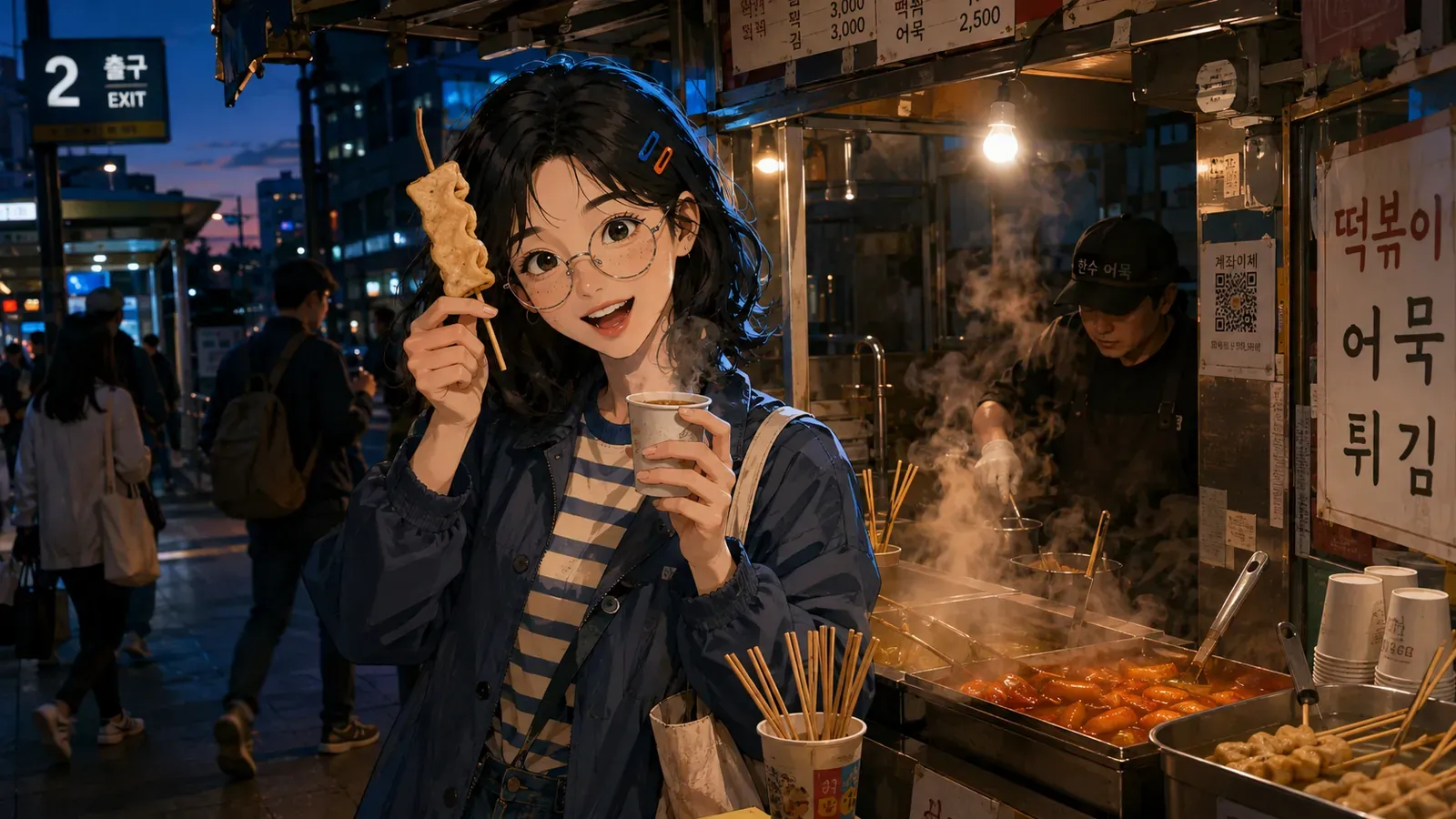
The "Seoul street food" you see in travel content is mostly Gwangjang Market (광장시장) or Myeongdong (명동) — packed, photogenic, and priced so one plate costs about what a meal should. That's Seoul too, but it isn't quite what people who live here actually buy off the street. The real everyday version isn't in the middle of a market. It's on the way home: outside subway exits, next to bus stops, at the mouth of a traditional market, along the backstreets near cram schools and offices. That's the version this is about. 🥢
The everyday version lives at subway exits, bus stops, and backstreets, not in the markets. Year-round: tteokbokki (~₩3,000 a cup, spicy — ask for deolmaepge or fall back on the non-spicy things next to it), eomuk fish cake on a skewer (₩1,000–1,500, and the broth is free and unlimited — big deal in winter), fried snacks, sundae, gilgeori toast (~₩2,000–4,000). November–March adds bungeoppang (now often ₩1,000 a piece after 2025's red-bean price spike), hotteok, and roasted sweet potato — you won't find these in summer. Pay in cash with small bills — stalls rarely take cards, and QR apps need a Korean bank account. Start with one non-spicy item to feel out the stall. The neighbourhood carts are genuinely in decline (regulation, costs, convenience-store competition), while the Myeongdong and Gwangjang stalls thrive on tourist demand.
What's on the street year-round
- Tteokbokki (떡볶이) — the default, sold pretty much everywhere. Around 3,000 won for a cup, 4,000–5,000 for a bowl or a takeaway box (a bit more around Sindang-dong (신당동), the tteokbokki district). One honest warning: it's spicy, and if you're not used to Korean spice it can be rougher than you expect. Some stalls will make it deolmaepge (덜 맵게, "less spicy") if you ask; if not, the non-spicy things next to it — fish cake, fried seaweed rolls, egg bread, toast — are an easy escape.
- Eomuk / odeng (어묵) — fish cake on a skewer, sold sitting in hot broth, roughly 1,000–1,500 won each. The broth is free and unlimited — take a paper cup and ask for more (gukmul jom deo juseyo, 국물 좀 더 주세요). In winter this matters a lot.
- Fried things (튀김) — squid, sweet potato, vegetable, seaweed rolls, about 1,000–3,000 won a piece. Dipping them in the tteokbokki sauce is standard.
- Sundae (순대) — blood sausage, 5,000–7,000 won a plate, dipped in salt or the spicy sauce.
- Gilgeori toast (길거리 토스트) — griddled white bread with shredded cabbage and carrot, a folded egg, ketchup, mayo, and a pinch of sugar. Around 2,000 won plain, more with egg or extra veg, roughly 4,000 for the works. Every stall's recipe is slightly different, which is why people have a regular one.
- Chicken skewers / tornado potato (닭꼬치 · 회오리감자) — common in nightlife areas and night markets. Skewers run a few thousand won; the spiral-cut potato on a stick is around 3,000–5,000, and you'll see it most in tourist-heavy spots like Myeongdong.
Treat every price here as approximate — it varies by stall and by neighborhood, and carts on the main tourist strips generally cost more than the ones in a residential area.
When it gets cold (roughly November–March)
- Bungeoppang / gukhwappang (붕어빵 · 국화빵) — fish- or flower-shaped pastries with red bean or custard. Three for 1,000–2,000 won used to be the rule, but after the price of Korean red beans jumped nearly 35% in a year in 2025, single pieces at 1,000 won each have become common — vendors will tell you flat out they raised prices because ingredients forced it.
- Hotteok (호떡) — a pressed, griddled pancake filled with brown sugar, cinnamon, and nuts, 1,500–2,500 won; there's also a seed-stuffed version.
- Roasted sweet potato / chestnuts (군고구마 · 군밤) — sold by weight or by the bag, roasted in a drum.
You won't see much of this in summer — if you're hunting for a bungeoppang cart in August, you probably won't find one. For a hot sit-down meal instead of a snack, see Seoul's winter bowls.
How to actually buy it
- Carry cash. Street stalls almost never take credit or debit cards. QR-transfer apps (KakaoPay, Naver Pay) are showing up at more carts, but those generally need a Korean bank account, so they're not much help on a short trip. Cash with small bills is the safe bet. (The big carts in tourist zones like Myeongdong are the exception — many of those do take cards.)
- Ordering is simple: say jeogeo juseyo (저거 주세요, "that one, please") and point at the tray next to you. Most people eat standing, and sharing space with a stranger at a tiny stall is normal.
- The sit-down evening tents (포장마차) around Jongno (종로) 3-ga, Euljiro (을지로), and Sindang-dong run from about 6pm until the early hours.
Why there's less of it than there used to be
Street vendors have visibly thinned out in ordinary neighborhoods. Tighter sanitation rules, enforcement and complaints, and a sharp rise in ingredient costs have all stacked up, and convenience-store hot counters are filling the gap — the number of convenience stores selling ready-made fish cake grew almost sevenfold in two years. People have even built "bungeoppang map" apps to crowdsource where the carts still are. Meanwhile the stalls in Myeongdong and Gwangjang Market are busier than ever on foreign demand — a slightly awkward split where the tourist version thrives while the neighborhood version fades.
 A Note From Daniel — our real human editor
Before my wife and I were married, back when we were dating, we spent a lot of time around Daehangno (대학로), near Hyehwa (혜화) station. We ate a lot of street food there. She loves tteokbokki, so we always got it together — the problem being that I don't handle spicy food well. I still have a very clear memory of standing on the street eating it, sweating through the whole thing.
 Rae's Tip
Don't order six things at your first stall. Start with one non-spicy item — fish cake or toast — get a feel for what that particular alley is like, and go from there. And keep small cash in your pocket, always. 🍢
For a different kind of evening, Hyehwa and Daehangno pairs one theatre performance with a walk toward the city wall.
Seoul's everyday street food lives at subway exits, bus stops, and backstreets, not in the markets. Year-round staples: tteokbokki (~3,000 won a cup), eomuk (1,000–1,500 won, with free unlimited broth), fried snacks, sundae, gilgeori toast, chicken skewers and tornado potato — all priced differently stall to stall. Bungeoppang, hotteok, and roasted sweet potato are mostly a November–March thing, and 2025's red-bean price spike has pushed bungeoppang toward 1,000 won per piece. Pay in cash — stalls rarely take cards, and QR payment apps really need a Korean bank account to be useful. Regulation, rising costs, and convenience-store competition mean the neighborhood stalls themselves are in decline.