Noryangjin Fish Market: Buy Downstairs, Eat Upstairs, and Know the Bill Before You Sit Down
It's a wholesale market that will cook for you, not a restaurant. How the buy-then-eat system works, what the bill really adds up to, and how to ask about the fees before you sit.

Partly personally verified — Daniel checked some of these in person
How we verify →·Last verified ·4 min read
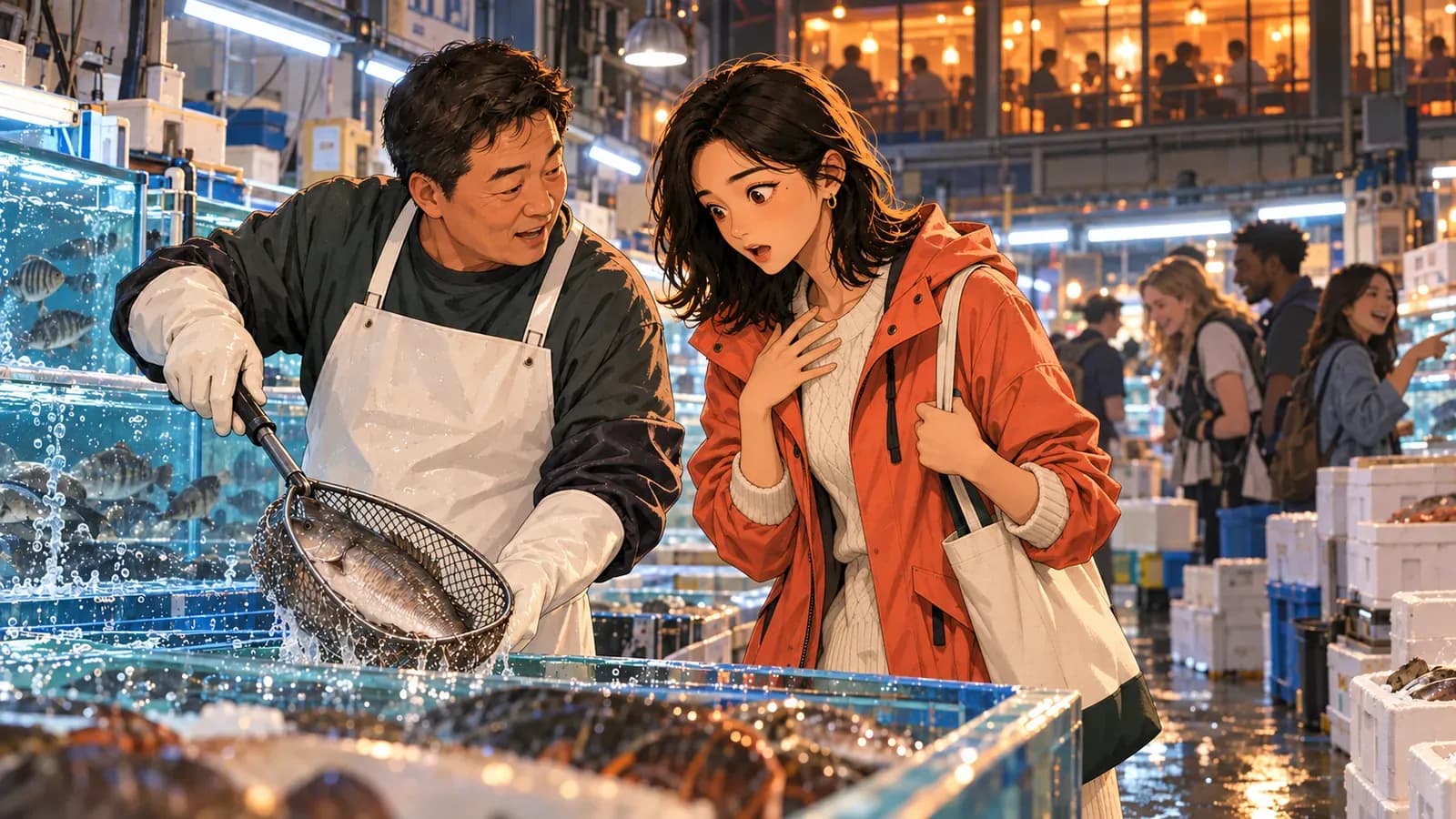
Noryangjin isn't a seafood restaurant. It's a wholesale market with a kitchen bolted on, and almost everything that goes wrong for visitors comes from treating it like the first thing when it's the second.
- It's a two-step system. Buy raw seafood from a stall on the first floor, then take it to a restaurant (mostly second floor) that slices or cooks it. The restaurant charges separately for the table, the sauces and the cooking.
- The bill comes in three parts: the seafood (a live fish runs roughly ₩30,000–50,000), a table charge (one April 2026 English guide puts it at ₩2,000–4,000 per person), and a cooking fee (about ₩5,000 per person for standard preparation, more for large items). Ask about all three before you sit. The numbers here are floors, and real bills can run higher.
- Getting there: Noryangjin Station, Line 1 Exit 9 (150 m) or Line 9 Exit 7 (70 m plus an underground passage). Retail is open year-round and the premium fish hall runs 00:00–24:00; the auction closes on Sundays and big holidays.
- Verdict: worth doing once if you want to pick your own fish and can say "no, thanks" to a vendor. If you want a calm sit-down dinner, a neighborhood raw-fish restaurant with one menu price is simpler.
What is Noryangjin Fish Market, and why isn't it just a restaurant?
Noryangjin Fisheries Wholesale Market (노량진수산시장), at 674 Nodeul-ro (노들로), Dongjak-gu (동작구), is a working wholesale market, so the auction runs in the small hours. The first floor holds the retail halls (live fish, shellfish, frozen and fresh fish) and the second floor holds the restaurants. The current building opened in 2016 and, according to The Soul of Seoul (April 2026), feels more like a shopping mall than the old market did. That split is the whole game. If you'd rather wander a market than buy from one, the traditional markets are the better fit.
How does buying and eating at Noryangjin actually work?
- Walk the first floor once. Vendors call out constantly; "just looking" is enough.
- Ask the price per kilo (or per fish) and the total. If you don't speak Korean, vendors often show the number on a calculator.
- Pay the stall. Someone from the stall will usually walk you to a restaurant it works with upstairs.
- The restaurant slices it into hoe (회), raw fish. You pay the stall for the seafood and the restaurant for the table setting and cooking.
- Anything cooked is extra. Spicy fish stew (maeuntang, 매운탕) and steamed or grilled shellfish each carry a fee.
What does the bill actually add up to?
Prices swing a lot by shop and by day, and these come from a handful of 2026 guides, so treat them as a rough floor: seafood, table charges and cooking fees can all run higher in practice.
| Item | Roughly (2026, treat as a floor) | Note |
|---|---|---|
| One live fish (to the stall) | ₩30,000–50,000 | Varies by species and size; two 2026 guides agree |
| Table charge (to the restaurant) | ₩2,000–4,000 per person | One guide (The Soul of Seoul, April 2026). Covers sauces and wrapping greens. Some reports run higher, so ask |
| Standard cooking fee (to the restaurant) | About ₩5,000 per person, up to ~₩8,000 more for something large | The Soul of Seoul, April 2026 |
| Steamed or grilled shellfish (to the restaurant) | About ₩5,000–10,000 per dish | One 2026 guide. Ask "per dish or per kilo?" |
| Set course at an upstairs restaurant (instead of choosing fish yourself) | About ₩53,000–80,000 per person | A February 2026 blog listing of some upstairs restaurants. Simpler if you'd rather not shop |
We couldn't find a current, dated price for drinks, so we left them out. Ask before you order.
Our arithmetic, not a quote: one live fish, a table charge for two and a standard cooking fee for two lands at at least roughly ₩44,000–68,000, before drinks and any extra dishes, and it can easily run higher. That total is us adding up the ranges above, not a price any stall gave us.
How do you avoid getting overcharged at Noryangjin?
A June 2026 Korean news report described a customer whose sea bream read 3.2 kg on the scale with the basket and 2.4 kg without it, and who was quoted ₩35,000 a kilo against ₩30,000 on a price app. It's one person's account, not proof of a pattern, but it's the kind of thing to guard against.
 A Note From Daniel — our real human editor
Even Seoul locals head to Noryangjin telling themselves not to get ripped off. With so many vendors competing under one roof, haggling is common. It helps to check the day's price first, on the market's official website or on Naver. It's the wholesale price, so retail runs higher, but it's plenty good enough for spotting a number that's way off. Once you're there, walk a lap, ask two or three stalls, agree on the price per kilo and the total, and keep an eye on the scale. The step people quietly skip is upstairs: ask a couple of restaurants for their table charge and cooking fee before you buy. You don't have to use the one a stall points you to, either. And if you haggle, you'll often walk away with a few extra pieces thrown in.
When should you go, and how do you get there?
- Getting there: from Noryangjin Station, take Line 1 Exit 9 and go straight about 150 m, or Line 9 Exit 7, go straight 70 m and pass through the underground passage. Line changes are in how to ride the Seoul subway.
- Hours: according to the market's own hours page and The Soul of Seoul (April 2026), retail sections run premium fish 00:00–24:00, general 01:30–22:00, shellfish 01:00–22:00, frozen 03:30–22:00. The market's page says retail is open year-round, and the auction closes on Sundays, New Year's Day, Seollal and Chuseok (a July 2026 news report lists the same closures). The market as a whole doesn't close, but individual vendors open when it suits them, so some stalls and restaurants may be shut on any given day, especially around holidays. Check first. Restaurants keep their own hours, and if you're staying late, see what to do if you miss the last train.
- Paying: shops taking part in a June 2026 market promotion accepted card or cash, but ask before you commit. For cash, cards vs cash.
What should you be careful with?
Live octopus (sannakji, 산낙지) can cling to the throat and cause choking. It's a genuine risk, and plenty of Korean locals won't eat it at all. The Korea Herald reported the death of an 82-year-old man in October 2023 (in Gwangju) and cited Seoul fire-department figures for several similar deaths over the years. The usual advice is to cut it small and chew thoroughly (general safety advice, not medical advice). Wear shoes with good grip, since the floors are wet, and for table manners see how to eat at a Korean restaurant.
Mina's verdict
Do it once, but go knowing it's a market, not a restaurant. It's not the cheapest way to eat fish in Seoul, and I won't pretend it is: a neighborhood raw-fish restaurant has one menu price, no haggling and no three-part bill. But choosing your own fish is something only Noryangjin does.
Buy raw seafood from a stall on the first floor, then take it to a second-floor restaurant that slices or cooks it. The bill has three parts: the seafood (a live fish is roughly ₩30,000–50,000), a table charge (₩2,000–4,000 per person in one April 2026 guide) and a cooking fee (about ₩5,000 per person for standard preparation). Ask for all three before you sit, and treat these numbers as a floor. Line 1 Exit 9 (150 m) or Line 9 Exit 7 (70 m + underground passage). Retail is open year-round (premium fish hall 00:00–24:00); the auction closes Sundays and big holidays.